Announcement

Collapse
No announcement yet.

Always wondered where that came from...

Collapse
X
 
  • Filter
  • Time
  • Show
Clear All
new posts

    Always wondered where that came from...

    I got bored and started flipping through a collection of Noh plays that I had to buy for a class I took fall semester, and I discovered that Naruto is the name of the whirlpool south of the island of Awaji. Awaji is between the Kyoto/Nara area and Shikoku and is considered to be the first island created by Izanagi and Izanami in the Japanese creation myth, according to the Kojiki. That may or may not be where they got the name for the anime character, but I thought it was interesting considering there was a filler episode where Naruto created a whirlpool.
     

    #2
    Re: Always wondered where that came from...

    Originally posted by Starba
    I got bored and started flipping through a collection of Noh plays that I had to buy for a class I took fall semester, and I discovered that Naruto is the name of the whirlpool south of the island of Awaji. Awaji is between the Kyoto/Nara area and Shikoku and is considered to be the first island created by Izanagi and Izanami in the Japanese creation myth, according to the Kojiki. That may or may not be where they got the name for the anime character, but I thought it was interesting considering there was a filler episode where Naruto created a whirlpool.

    What is Noh? And what anime are you referrring to?

    Comment


      #3
      Re: Always wondered where that came from...

      Naruto is also that topping for ramen with the swirly design.

      Swirly = whirlpool.

      Comment


        #4
        Re: Always wondered where that came from...

        Originally posted by Perversion
        What is Noh?
        Noh is a type of play. http://en.wikipedia.org/wiki/Noh
        http://www.youtube.com/user/Goufunaki

        Comment


          #5
          Re: Always wondered where that came from...

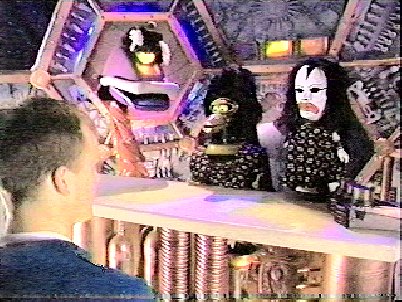
          CROW
          Hello and....

          BOTS
          Konnichi wa!

          SERVO
          Tonight we present a traditional Japanese Kabuki play. Translated to English, this ancient work is entitled Neil Simon's The Sunshine Boys.

          Now, how many of you are familiar with Japanese theater?

          (NELSON looks around. He's the only one in an audience of folding chairs).

          Anybody field this one... Anyone at all...(NELSON tentatively raises his hand) Ah yes, you sir; and you enjoy Kabuki theater?

          NELSON
          Uh, actually I prefer Noh theater.

          CROW
          Well, then, why did you raise your hand?

          NELSON
          Because I like Noh theater. Noh plays are my favorite.

          SERVO
          So you don't like any theater at all?

          NELSON
          No, let me explain. Noh theater is classic Japanese drama. Noh plays have been produced since the 13th century, and Noh actors are revered even today.

          CROW
          Why are you dissing Japanese theater? What's your deal, man?

          NELSON
          No, wait a minute! Noh theater started in Japan...

          SERVO
          Oh, so now you tell us Japan doesn't have any theater whatsoever?

          NELSON
          They have lots of theater, including Noh theater!

          CROW
          So they have lots of theater and they have no theater?

          NELSON
          Exactly!

          SERVO
          No theater?

          CROW
          What?

          NELSON
          Yes!

          BOTS
          WHAT?!

          NELSON
          Noh theater!!!! N...O....H!!!!

          SERVO
          N-O-H, huh? There you just go and show what an idiot you are!

          CROW
          I'll handle this, Tom, calm down! Mike: I'm going to ask you a series of simple questions which even a cretin like you could answer yes or no.

          Now, is there theater in Japan?

          NELSON
          Yes.

          CROW
          Good, and do you have a particular favorite type of Japanese theater?

          NELSON
          Yes.

          CROW
          Well, good, now we're getting somewhere! Mike: will you tell me the name of your favorite form of Japanese theater?

          NELSON
          Noh!

          CROW
          Why not?

          NELSON
          Why not what?!

          CROW
          Why won't you tell me your favorite Japanese theater?

          NELSON
          I just did.

          CROW
          Did what?!

          NELSON (spits out each word)
          Told you my favorite form of Japanese theater!

          CROW
          You did?

          NELSON
          Yes!!!

          CROW
          Well, will you tell me again?

          NELSON
          Yes! NOH!

          SERVO
          Oh, come on!

          CROW
          Mike, I'm going to grab a step ladder so you can jump up my butt!

          SERVO
          May we do our little Kabuki play now?

          NELSON
          Yes, but just remember I like Noh theater better than I like Kabuki theater.

          CROW
          I thought you didn't like Kabuki!

          NELSON
          I do!!!

          BOTS
          AAHHHHHH!!

          Comment


            #6
            Re: Always wondered where that came from...

            Anybody remember the Whos?

            Yeah me neither. I just heard about them on Animaniacs.
            Last edited by ErikaFuzzbottom; 05-20-2006, 04:19 PM.
            "What if like...there was an exact copy of you somewhere, except they're the opposite gender, like you guys could literally have a freaky friday moment and nothing would change. Imagine the best friendship that could be found there."

            Comment


              #7
              Re: Always wondered where that came from...

              And my world just got a little bit smaller.

              I haven't watched Naruto in awhile, but my friends are saying there's not much worth watching after around ep. 140. Oh well, it was good while it lasted. At least I saw drunken boxing.

              Noh plays, by the way, are a traditional form of Japanese theater recognizeable for its sparse stage, gorgeous costumes, and stylized masks, that usually features Japanese myths, history, and legends from about 600 AD to 1100 AD (although during Toyotomi Hideyoshi's rule in the late 1500s many plays were written about and by him, featuring him as the star actor, no less). The most revered writers whose plays are considered to make up most of the ~200 play canon are Zeami, Kan'ami (his father), Motomasa (his son), and Komparu Zenchiku (the heir to his style), who all wrote between 1300 and 1500, although often they would embellish on plays performed long before their time. Noh first received the patronage of the shogunate under Ashikaga Yoshimitsu in 1374 when he took the young Zeami as his boy lover, before which time the Noh theater (called sarugaku at the time) was a traveling act that performed in front of any audience who would listen, varying from celebratory religious rituals at shrines to entertainment in front of farmers while they planted rice. By 1600, when Tokugawa Ieyasu established his shogunate, Noh actors were forced to register as acting families and the Noh repertoire, dance, and costume styles began to refine and standardize. Noh theater has not changed considerably since this time, and plays are still passed down orally from father to son and performed in a few set theaters, mainly in Nara, Kyoto, and Tokyo.

              Japanese culture is ripe with references to Noh, even if the average person has never seen a single play. The drum, flute, and "iiiYOOOoooo" vocal sound you often hear in anime is the background "music" and tempo to Noh plays, the dozens of masks are very common images throughout society, and the legends are evoked regularly. Some actors are even so well-known that they get leading parts in popular movies, although noh acting is a very different thing from TV acting.

              Anyway, that's Noh. Here are some pictures:


              The main actor of a play (called a shite), dressed as a woman. There are five types of Noh plays, all with a distinct style and mood: celebratory plays, warrior plays, woman plays, miscellaneous plays, and demon plays.


              The battle scene of a demon play. The guy on the right is a yamabushi, or mountain priest, who is something like a shinto witch doctor.


              Some Noh masks are very specific, for one play only, and others can be used in a wide variety of different plays. This mask is a demon mask, recognizeable by its red coloring (red is base and demonic, while white is aristocratic and enlightened) and golden eyes. However, without the golden eyes, it could double as a human character, like Benkei. It has a companion mask with an open mouth, reminiscent of the guardian statues in front of shrines and other holy places.


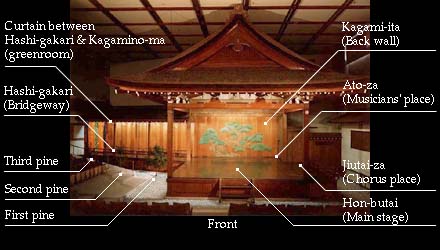
              The Noh stage. All Noh stages have virtually the same set-up, as the locations are very important due to the standardization of dance, entrances, exits, etc. Musicians sit in the back and the chorus to the right. They enter through a hidden door to the right while the bridge to the left is reserved for the actors.


              The standard placement of Noh musicians. The the musicians and the music they play (including vocal calls by the drummers) are nonexistant to the performance, but the actors and music have a dialogue that both sets the tempo for the play and remind each other when to start and stop a dance, etc. Every play will feature a shoulder drum, hip drum, and flute, but some more active ones will also have a floor drum called taiko.


              The mask of the old man Okina. When painted black, it is called Sambaso. The play featuring Okina and Sambaso (today called just Okina) is very different from other Noh plays in that it is entirely ritualistic, used in celebration and to purify a stage before performance. It is always the first play performed when a new stage is constructed. Okina is thought to be the oldest play in the Noh repertoire, and the unique mask with a hinged jaw is of a style no longer used in Japan, but has been found in other countries.
               

              Comment


                #8
                Re: Always wondered where that came from...

                All hail Starba, Goddess of all that is nerddom.
                The unnecessary felling of a tree, perhaps the growth of centuries, seems to me a crime little short of murder." ~ Thomas Jefferson

                Comment


                  #9
                  Re: Always wondered where that came from...

                  The anime Gasaraki also incorporates Noh theater into its plot somehow. While interesting the story seemed too dry for me.

                  Comment


                    #10
                    Re: Always wondered where that came from...

                    I'm also reminded of Nob'dy.

                    "Nob'dy is bothering me! Nob'dy hurt me!"
                    Shame I can't remember his real name.
                    "What if like...there was an exact copy of you somewhere, except they're the opposite gender, like you guys could literally have a freaky friday moment and nothing would change. Imagine the best friendship that could be found there."

                    Comment


                      #11
                      Re: Always wondered where that came from...

                      Damn, Kefka beat me to it. Possibly their best host segment.

                      Comment


                        #12
                        Re: Always wondered where that came from...

                        Otogi Zoshi also refers to Noh in the first half, but not by name. Takahashi Rumiko draws upon it pretty heavily for Inuyasha, too. For some reason that's beyond me, even Record of Lodoss War uses the drum call for its chapter intros.

                        It's hard for Noh not to be dry--even die-hard fans admit to falling asleep. Actually, the aikyogen interludes in which a kyogen actor will drone on and on while the shite changes costume are as long as the play itself sometimes and are intentionally dull so as not to upstage the main performance.

                        Still, in small doses it's fascinating in its special way.
                         

                        Comment

                        Working...
                        X