
Announcement

Collapse
No announcement yet.

Let's take the Assburgers and Meyer's Briggs Test

Collapse
X
 
  • Filter
  • Time
  • Show
Clear All
new posts

    Let's take the Assburgers and Meyer's Briggs Test


    Your Aspie score: 42 of 200
    Your neurotypical (non-autistic) score: 172 of 200
    You are very likely neurotypical
    Your MBTI type: ENTP


    Extraverted iNtuitive Thinking Perceiving

    "Clever" is the word that perhaps describes ENTPs best. The professor who juggles half a dozen ideas for research papers and grant proposals in his mind while giving a highly entertaining lecture on an abstruse subject is a classic example of the type. So is the stand-up comedian whose lampoons are not only funny, but incisively accurate.

    ENTPs are usually verbally as well as cerebrally quick, and generally love to argue--both for its own sake, and to show off their often-impressive skills. They tend to have a perverse sense of humor as well, and enjoy playing devil's advocate. They sometimes confuse, even inadvertently hurt, those who don't understand or accept the concept of argument as a sport.

    ENTPs are as innovative and ingenious at problem-solving as they are at verbal gymnastics; on occasion, however, they manage to outsmart themselves. This can take the form of getting found out at "sharp practice"--ENTPs have been known to cut corners without regard to the rules if it's expedient -- or simply in the collapse of an over-ambitious juggling act. Both at work and at home, ENTPs are very fond of "toys"--physical or intellectual, the more sophisticated the better. They tend to tire of these quickly, however, and move on to new ones.

    ENTPs are basically optimists, but in spite of this (perhaps because of it?), they tend to become extremely petulant about small setbacks and inconveniences. (Major setbacks they tend to regard as challenges, and tackle with determin- ation.) ENTPs have little patience with those they consider wrongheaded or unintelligent, and show little restraint in demonstrating this. However, they do tend to be extremely genial, if not charming, when not being harassed by life in general.

    In terms of their relationships with others, ENTPs are capable of bonding very closely and, initially, suddenly, with their loved ones. Some appear to be deceptively offhand with their nearest and dearest; others are so demonstrative that they succeed in shocking co-workers who've only seen their professional side. ENTPs are also good at acquiring friends who are as clever and entertaining as they are. Aside from those two areas, ENTPs tend to be oblivious of the rest of humanity, except as an audience -- good, bad, or potential.

    Some Famous ENTPs:

    Alexander the Great
    Confederate General J. E. B. Stuart
    Sir Walter Raleigh
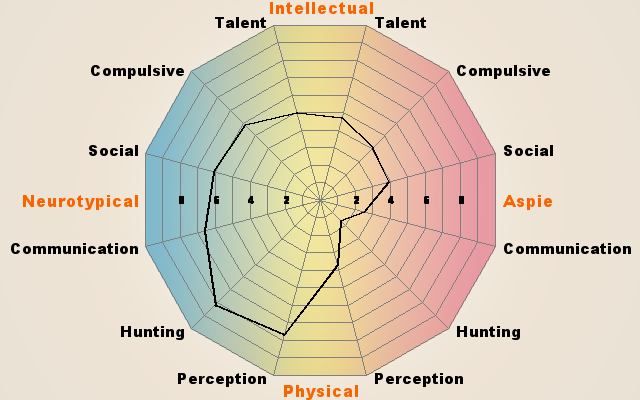
    people with ADD need not apply, the quiz is pretty long

    #2
    Re: Let's take the Assburgers and Meyer's Briggs Test

    Your Aspie score: 79 of 200
    Your neurotypical (non-autistic) score: 136 of 200
    You are very likely neurotypical
    Your MBTI type: ENFP


    Famous ENFPs
    Dr. Seuss
    Bill Cosby
    Robin Williams
    Robert Downey Jr.
    Andy Kaufman
    Will Smith

    Comment


      #3
      Re: Let's take the Assburgers and Meyer's Briggs Test

      Let's get the ball rolling:

      Your Aspie score: 128 of 200
      Your neurotypical (non-autistic) score: 86 of 200
      You are very likely an Aspie
      Your MBTI type: ENTJ


      Comment


        #4
        Re: Let's take the Assburgers and Meyer's Briggs Test


        Your Aspie score: 124 of 200
        Your neurotypical (non-autistic) score: 87 of 200
        You are very likely an Aspie
        Your MBTI type: INFP

        "I remember the first albatross I ever saw. ... At intervals, it arched forth its vast archangel wings, as if to embrace some holy ark. Wondrous flutterings and throbbings shook it. Though bodily unharmed, it uttered cries, as some king's ghost in super natural distress. Through its inexpressible, strange eyes, methought I peeped to secrets not below the heavens. As Abraham before the angels, I bowed myself..." --(Herman Melville, Moby Dick)
        INFPs never seem to lose their sense of wonder. One might say they see life through rose-colored glasses. It's as though they live at the edge of a looking-glass world where mundane objects come to life, where flora and fauna take on near-human qualities.

        INFP children often exhibit this in a 'Calvin and Hobbes' fashion, switching from reality to fantasy and back again. With few exceptions, it is the NF child who readily develops imaginary playmates (as with Anne of Green Gables's "bookcase girlfriend"--her own reflection) and whose stuffed animals come to life like the Velveteen Rabbit and the Skin Horse:

        "...Generally, by the time you are Real, most of your hair has been loved off, and your eyes drop out and you get loose in the joints and very shabby. But these things don't matter at all, because once you are Real you can't be ugly, except to people who don't understand..." (the Skin Horse)
        INFPs have the ability to see good in almost anyone or anything. Even for the most unlovable the INFP is wont to have pity.

        Rest you, my enemy,
        Slain without fault,
        Life smacks but tastelessly
        Lacking your salt!
        Stuck in a bog whence naught
        May catapult me,
        Come from the grave, long-sought,
        Come and insult me!
        --(Steven Vincent Benet, Elegy for an Enemy)
        Their extreme depth of feeling is often hidden, even from themselves, until circumstances evoke an impassioned response:

        "I say, Queequeg! Why don't you speak? It's I--Ishmael." But all remained still as before. ... Something must have happened. Apoplexy!
        ... And running up after me, she caught me as I was again trying to force open the door. ... "Have to burst it open," said I, and was running down the entry a little, for a good start, when the landlady caught me, again vowing I should not break down her premises; but I tore from her, and with a sudden bodily rush dashed myself full against the mark.--(Melville, Moby Dick)
        Of course, not all of life is rosy, and INFPs are not exempt from the same disappointments and frustrations common to humanity. As INTPs tend to have a sense of failed competence, INFPs struggle with the issue of their own ethical perfection, e.g., perfo rmance of duty for the greater cause. An INFP friend describes the inner conflict as not good versus bad, but on a grand scale, Good vs. Evil. Luke Skywalker in Star Wars depicts this conflict in his struggle between the two sides of "The Force." Although the dark side must be reckoned with, the INFP believes that good ultimately triumphs.

        Some INFPs have a gift for taking technical information and putting it into layman's terms. Brendan Kehoe's Zen and the Art of the Internet is one example of this "de-jargoning" talent in action.

        Functional Analysis:

        Introverted Feeling
        INFPs live primarily in a rich inner world of introverted Feeling. Being inward-turning, the natural attraction is away from world and toward essence and ideal. This introversion of dominant Feeling, receiving its data from extraverted intuition, must be the source of the quixotic nature of these usually gentle beings. Feeling is caught in the approach- avoidance bind between concern both for people and for All Creatures Great and Small, and a psycho-magnetic repulsion from the same. The "object," be it homo sapiens or a mere representation of an organism, is valued only to the degree that the object contains some measure of the inner Essence or greater Good. Doing a good deed, for example, may provide intrinsic satisfaction which is only secondary to the greater good of striking a blow against Man's Inhumanity to Mankind.
        Extraverted iNtuition
        Extraverted intuition faces outward, greeting the world on behalf of Feeling. What the observer usually sees is creativity with implied good will. Intuition spawns this type's philosophical bent and strengthens pattern perception. It combines as auxiliary with introverted Feeling and gives rise to unusual skill in both character development and fluency with language--a sound basis for the development of literary facility. If INTPs aspire to word mechanics, INFPs would be verbal artists.
        Introverted Sensing
        Sensing is introverted and often invisible. This stealth function in the third position gives INFPs a natural inclination toward absent- mindedness and other-worldliness, however, Feeling's strong people awareness provides a balancing, mitigating effect. This introverted Sensing is somewhat categorical, a subdued version of SJ sensing. In the third position, however, it is easily overridden by the stronger functions.
        Extraverted Thinking
        The INFP may turn to inferior extraverted Thinking for help in focusing on externals and for closure. INFPs can even masquerade in their ESTJ business suit, but not without expending considerable energy. The inferior, problematic nature of Extraverted Thinking is its lack of context and proportion. Single impersonal facts may loom large or attain higher priority than more salient principles which are all but overlooked.
        Famous INFPs:
        Homer
        Virgil
        Mary, mother of Jesus
        St. John, the beloved disciple
        St. Luke; physician, disciple, author
        William Shakespeare, bard of Avon
        Henry Wadsworth Longfellow (Evangeline)
        A. A. Milne (Winnie the Pooh)
        Laura Ingalls Wilder (Little House on the Prairie)
        Helen Keller, deaf and blind author
        Carl Rogers, reflective psychologist, counselor
        Fred Rogers (Mister Rogers' Neighborhood)
        Dick Clark (American Bandstand)
        Donna Reed, actor (It's a Wonderful Life)
        Jacqueline Kennedy Onasis
        Neil Diamond, vocalist
        Tom Brokaw, news anchor
        James Herriot (All Creatures Great and Small)
        Annie Dillard (Pilgrim at Tinker Creek)
        James Taylor, vocalist
        Julia Roberts, actor (Conspiracy Theory, Pretty Woman)
        Scott Bakula (Quantum Leap)
        Terri Gross (PBS's "Fresh Air")
        Amy Tan (author of The Joy-Luck Club, The Kitchen God's Wife)
        John F. Kennedy, Jr.
        Lisa Kudrow ("Phoebe" of Friends)
        Fred Savage ("The Wonder Years")
        "Pardon me, I have nothing to say!" -George Carlin

        Comment


          #5
          Re: Let's take the Assburgers and Meyer's Briggs Test


          Your Aspie score: 120 of 200
          Your neurotypical (non-autistic) score: 81 of 200
          You are very likely an Aspie
          Your MBTI type: INFP

          Introverted iNtuitive Feeling Perceiving
          INFPs never seem to lose their sense of wonder. One might say they see life through rose-colored glasses. It's as though they live at the edge of a looking-glass world where mundane objects come to life, where flora and fauna take on near-human qualities.

          INFP children often exhibit this in a 'Calvin and Hobbes' fashion, switching from reality to fantasy and back again. With few exceptions, it is the NF child who readily develops imaginary playmates (as with Anne of Green Gables's "bookcase girlfriend"--her own reflection) and whose stuffed animals come to life like the Velveteen Rabbit and the Skin Horse.

          INFPs have the ability to see good in almost anyone or anything. Even for the most unlovable the INFP is wont to have pity.

          Their extreme depth of feeling is often hidden, even from themselves, until circumstances evoke an impassioned response.

          Of course, not all of life is rosy, and INFPs are not exempt from the same disappointments and frustrations common to humanity. As INTPs tend to have a sense of failed competence, INFPs struggle with the issue of their own ethical perfection, e.g., perfo rmance of duty for the greater cause. An INFP friend describes the inner conflict as not good versus bad, but on a grand scale, Good vs. Evil. Luke Skywalker in Star Wars depicts this conflict in his struggle between the two sides of "The Force." Although the dark side must be reckoned with, the INFP believes that good ultimately triumphs.

          Some INFPs have a gift for taking technical information and putting it into layman's terms. Brendan Kehoe's Zen and the Art of the Internet is one example of this "de-jargoning" talent in action.

          Famous INFPs:
          Homer
          Virgil
          William Shakespeare, bard of Avon
          Helen Keller, deaf and blind author
          Fred Rogers (Mister Rogers' Neighborhood)
          John F. Kennedy, Jr.

          Comment


            #6
            Re: Let's take the Assburgers and Meyer's Briggs Test


            Your Aspie score: 70 of 200
            Your neurotypical (non-autistic) score: 116 of 200
            You are very likely neurotypical
            Your MBTI type: INFP

            Sivart: I'm a MAN.

            Comment


              #7
              Re: Let's take the Assburgers and Meyer's Briggs Test

              Your Aspie score: 58 of 200
              Your neurotypical (non-autistic) score: 155 of 200
              You are very likely neurotypical
              Your MBTI type: ENFP


              I took Myers-Briggs over the summer and got INFP, though.

              Comment


                #8
                Re: Let's take the Assburgers and Meyer's Briggs Test

                Your Aspie score: 42 of 200
                Your neurotypical (non-autistic) score: 149 of 200
                You are very likely neurotypical
                Your MBTI type: INTP

                Last edited by ChaosKnightXD; 02-13-2010, 01:44 PM.

                Comment


                  #9
                  Re: Let's take the Assburgers and Meyer's Briggs Test

                  Your Aspie score: 39 of 200
                  Your neurotypical (non-autistic) score: 166 of 200
                  You are very likely neurotypical
                  Your MBTI type: ENFJ


                  Extraverted iNtuitive Feeling Judging

                  ENFJs are the benevolent 'pedagogues' of humanity. They have tremendous charisma by which many are drawn into their nurturant tutelage and/or grand schemes. Many ENFJs have tremendous power to manipulate others with their phenomenal interpersonal skills and unique salesmanship. But it's usually not meant as manipulation -- ENFJs generally believe in their dreams, and see themselves as helpers and enablers, which they usually are.

                  ENFJs are global learners. They see the big picture. The ENFJs focus is expansive. Some can juggle an amazing number of responsibilities or projects simultaneously. Many ENFJs have tremendous entrepreneurial ability.

                  ENFJs are, by definition, Js, with whom we associate organization and decisiveness. But they don't resemble the SJs or even the NTJs in organization of the environment nor occasional recalcitrance. ENFJs are organized in the arena of interpersonal affairs. Their offices may or may not be cluttered, but their conclusions (reached through feelings) about people and motives are drawn much more quickly and are more resilient than those of their NFP counterparts.

                  ENFJs know and appreciate people. Like most NFs, (and Feelers in general), they are apt to neglect themselves and their own needs for the needs of others. They have thinner psychological boundaries than most, and are at risk for being hurt or even abused by less sensitive people. ENFJs often take on more of the burdens of others than they can bear.

                  Famous ENFJs:

                  Barack Obama
                  Sean Connery
                  Dick Van Dyke
                  Andy Griffith
                  Tommy Lee Jones
                  Oprah Winfrey
                  Michael Jordan
                  Johnny Depp

                  ~Updates weekly on Sundays~

                  Comment


                    #10
                    Re: Let's take the Assburgers and Meyer's Briggs Test

                    Originally posted by Dreamknight View Post
                    I took Myers-Briggs over the summer and got INFP, though.
                    I took it a year ago and got ENFJ (like RPG Dork above me). Probably has to do with the test or that nobody fits these molds to a "t".

                    Looks like we've got a lot a variety, here.
                    Last edited by Toaster; 02-14-2010, 02:36 AM.

                    Comment


                      #11
                      Re: Let's take the Assburgers and Meyer's Briggs Test

                      Your Aspie score: 102 of 200
                      Your neurotypical (non-autistic) score: 114 of 200
                      You seem to have both Aspie and neurotypical traits
                      Your MBTI type: ENTP


                      NTP is usually what I get but for some reason this quiz thinks I'm an extrovert. Anyone who knows me can vouch that that's not really true. xP

                      Comment


                        #12
                        Re: Let's take the Assburgers and Meyer's Briggs Test

                        Your Aspie score: 106 of 200
                        Your neurotypical (non-autistic) score: 95 of 200
                        You seem to have both Aspie and neurotypical traits
                        Your MBTI type: INTP


                        Introverted iNtuitive Thinking Perceiving

                        INTPs are pensive, analytical folks. They may venture so deeply into thought as to seem detached, and often actually are oblivious to the world around them.

                        Precise about their descriptions, INTPs will often correct others (or be sorely tempted to) if the shade of meaning is a bit off. While annoying to the less concise, this fine discrimination ability gives INTPs so inclined a natural advantage as, for example, grammarians and linguists.

                        INTPs are relatively easy-going and amenable to almost anything until their principles are violated, about which they may become outspoken and inflexible. They prefer to return, however, to a reserved albeit benign ambiance, not wishing to make spectacles of themselves.

                        A major concern for INTPs is the haunting sense of impending failure. They spend considerable time second-guessing themselves. The open-endedness (from Perceiving) conjoined with the need for competence (NT) is expressed in a sense that one's conclusion may well be met by an equally plausible alternative solution, and that, after all, one may very well have overlooked some critical bit of data. An INTP arguing a point may very well be trying to convince himself as much as his opposition. In this way INTPs are markedly different from INTJs, who are much more confident in their competence and willing to act on their convictions.

                        Mathematics is a system where many INTPs love to play, similarly languages, computer systems--potentially any complex system. INTPs thrive on systems. Understanding, exploring, mastering, and manipulating systems can overtake the INTP's conscious thought. This fascination for logical wholes and their inner workings is often expressed in a detachment from the environment, a concentration where time is forgotten and extraneous stimuli are held at bay. Accomplishing a task or goal with this knowledge is secondary.

                        INTPs and Logic -- One of the tipoffs that a person is an INTP is her obsession with logical correctness. Errors are not often due to poor logic -- apparent faux pas in reasoning are usually a result of overlooking details or of incorrect context.

                        Famous INTPs:

                        Socrates
                        Rene Descartes
                        Blaise Pascal
                        Sir Isaac Newton

                        U.S. Presidents:
                        James Madison
                        John Quincy Adams
                        John Tyler
                        Dwight D. Eisenhower
                        Gerald Ford

                        William Harvey (pioneer in human physiology)
                        C. G. Jung, (Freudian defector, author of Psychological Types, etc.)
                        William James
                        Albert Einstein
                        Tom Foley (1989-1995: Speaker of the House--U.S. House of Representatives)
                        Henri Mancini
                        Bob Newhart
                        Jeff Bingaman, U.S. Senator (D.--NM)
                        Rick Moranis (Honey, I Shrunk The Kids)
                        Midori Ito (ice skater, Olympic silver medalist)
                        Tiger Woods
                        Last edited by Cosmic Jeff; 02-13-2010, 05:24 PM.

                        Comment


                          #13
                          Re: Let's take the Assburgers and Meyer's Briggs Test

                          Your Aspie score: 116 of 200
                          Your neurotypical (non-autistic) score: 96 of 200
                          You seem to have both Aspie and neurotypical traits
                          Your MBTI type: INTP (most other tests have put me as INTJ)

                          Comment


                            #14
                            Re: Let's take the Assburgers and Meyer's Briggs Test

                            Your Aspie score: 122 of 200
                            Your neurotypical (non-autistic) score: 74 of 200
                            You are very likely an Aspie
                            Your MBTI type: INFP

                            Last edited by Armored; 02-13-2010, 07:03 PM.

                            Comment


                              #15
                              Re: Let's take the Assburgers and Meyer's Briggs Test

                              Your Aspie score: 122 of 200
                              Your neurotypical (non-autistic) score: 85 of 200
                              You are very likely an Aspie
                              Your MBTI type: ISTP

                              Like their fellow SPs, ISTPs are fundamentally Performers (note the capital 'P' :-)), but as Ts their areas of interest tend to be mechanical rather than artistic like those of ISFPs, and unlike most ESPs they do not present an impression of constant activity. On the contrary, they lie dormant, saving their energy until a project or an adventure worthy of their time comes along--and then they launch themselves at it. The apparently frenzied state that inevitably ensues is actually much more controlled than it appears--ISTPs always seem to know what they're doing when it comes to physical or mechanical obstacles--but the whole chain of events presents a confusing and paradoxical picture to an outsider.
                              ISTPs are equally difficult to understand in their need for personal space, which in turn has an impact on their relationships with others. They need to be able to "spread out"--both physically and psychologically--which generally implies encroaching to some degree on others, especially if they decide that something of someone else's is going to become their next project. (They are generally quite comfortable, however, with being treated the same way they treat others--at least in this respect.) But because they need such a lot of flexibility to be as spontaneous as they feel they must be, they tend to become as inflexible as the most rigid J when someone seems to be threatening their lifestyle (although they usually respond with a classic SP rage which is yet another vivid contrast to their "dormant," impassive, detached mode). These territorial considerations are usually critical in relationships with ISTPs; communication also tends to be a key issue, since they generally express themselves non-verbally. When they do actually verbalize, ISTPs are masters of the one-liner, often showing flashes of humor in the most tense situations; this can result in their being seen as thick-skinned or tasteless.
                              Like most SPs, ISTPs may have trouble with rote and abstract classroom learning, which tend not to be good measures of their actual intelligence. They tend, sometimes with good reason, to be highly skeptical of its practical value, and often gravitate towards classes in industrial arts; part-time vocational/ technical programs can be useful to even the college-bound ISTP. In terms of careers, mechanics and any of the skilled trades are traditional choices, and those ISTPs with strong numerical as well mechanical gifts tend to do extremely well in most areas of engineering. Working as paramedics or firefighters can fulfill the ISTP need to live on the edge; they are at their best in a crisis, where their natural disregard for rules and authority structures allows them to focus on and tackle the emergency at hand in the most effective way.
                              ISTPs with more sedate careers usually take on high-risk avocations like racing, skydiving, and motorcycling. While aware of the dangers involved, they are so in touch with the physical world that they know they can get away with much smaller safety margins than other types.
                              Not even close. I sound pretty much spot on with ENTP

                              Comment

                              Working...
                              X