Announcement

Collapse
No announcement yet.

Why the electric car failed

Collapse
X
 
  • Filter
  • Time
  • Show
Clear All
new posts

    #31
    Re: Why the electric car failed

    I'm hoping electric cars will become more availible in the future. 300 miles per charge is attractive.

    "Develop your skills wisely...
    youth doesn't last forever" - Rockman Dash 2

    Comment


      #32
      Re: Why the electric car failed

      In theory I could build an electric car.

      In theory, communism works.

      Comment


        #33
        Re: Why the electric car failed

        Originally posted by Redneck 2000
        In theory I could build an electric car.

        In theory, communism works.

        Comment


          #34
          Re: Why the electric car failed

          Ofcourse I had to quote the whole thing...

          Comment


            #35
            Re: Why the electric car failed

            Just read it, Bob.
            "Mindless killing doesn't do a lot for me anymore." - Sampson

            Comment


              #36
              Re: Why the electric car failed

              The EV isn't a total failure. They incorporated EV technology into the Hybrid vehicles which get 40+ MPG depending on the model you get(http://www.fueleconomy.gov/feg/hybrid_sbs.shtml). They did this to get fuel effeciency, electric torque, and gas power all in one. Another reason they haven't fully caught on both EV's and Hybrids is due to the fact the amount of electricity that runs them. The Hybrid's electric motor is running off 10,000+ volts of electrcity and the amperage is fataly high to humans! The EV is the same. This leads to problems of working on the vehicle. If a mechanic makes one wrong turn of a wrench and he's dead (I know this because I worked at a garage and we recieved info packets from the vehicle manufatures explaining the risk invovled). Converting a gas to an EV is also as dangerous. If you ground a battery wrong then you can cause a battery to explode or even worse fry your electric motor or even yourself. But thats the risk you take while building an electric car. High school built vehicles are under more stricter safety rules then home built ones but the danger is still the same. As for cost, its about $5,000-$10,000 depending on the parts you get. However if you wanted to get the Nickel Batterys or the Lithium Ion batterys then be prepared to spend double to triple that amount but you get better longer lasting batteries. One reason car manufacture don't make em is cause they cost more money then gas vehicles do. They can cost as much as $30,000 plus to make. (A Hybrid now cost $30,000, depending on the model, to buy now and has better power and longer range then its EV or gas equivalent) and for business to stay in business need to make a profit so the markup is usually 10%+.
              Another factor for them not catching on is the fact that it takes several hours to recharge. Are you willing to sit at a recharge station every 300 miles (if your lucky) for several hours? I doubt it. And where does electricty come from might I ask? Thats right power plants which run off coal or oil most of the time so how are you helping other then draining more power? The cost of a kilowatt (measure of electricity) varys by area but it is cheaper then gas by a few cents a mile.
              According to howstuffworks.com (http://auto.howstuffworks.com/electric-car.htm) their sample vehicle only gets a 50 mile range, 0-60 in 15 seconds, and the batteries alone weigh 1,100 pounds! Thats a home converted EV mind you. To get a drag racer out of an EV you would have to use ultra light weight materials and enough batteries to get you the needed power. Any more weight and you begin to lose seconds.
              EV's aren't totally free of pollution eiether. They still require maintaince, not as much as gas but they do require maintaince, mostly cleaning the corrosion off the batterys, which is highly acidic. They require electrcity to be recharged and as said before to get that powers has to come from a plant which still puts out emissions. Third, what happens to the batteries once they been used up? They have to go somewhere and 1,000 pounds of batteries is a lot to throw away or even recycycle.
              The government is doing everything they can to make fuel efficent cars better and more efficent (thus the reason why cars have so much computers attached to them). They even have a website, http://www.fueleconomy.gov/ . Bush is even pressuring car companys into developing them and having them ready for market as soon as possible.
              As for car companys, they ain't holding back. This is a new market for them as well and with new markets means newer and better ways to make money, thus the reason Toyota, Honda, GM, Ford and most major, if not all, car companys are investing millions to billions of dollars to get this started. Oil companys are even getting into the fuel cell business cause it opens a newer market for them, its called Hydrogen. This market can make even more money for them due to the fact there is no drilling invovled or strict laws governing its extraction. Even gas stations wanna get a piece of the pie, but for them it cost far to much to convert to supply hydrogen since the technology is far to new. And since mass producing and creating supply lines of Hydrogen is cost beyond econimical means Fuel Cells will take awhile before the price becomes feasible to put on the market. If fuel cells were put on the market now they would cost millions. But we can see fuel cells in the very near future. Look at this site if you would like to know more about Fuel Cell technogly, including facts, progress and challenges, http://www.gm.com/company/gmability/...fcv/index.html It is a GM website but i recommend them since they are leading they way in Fuel Cell technogy. But with everything else in life, look into other sources to get an even better picture.
              These are the reasons EV's never caught on and the reasons Hybrids and Fuel Cells have became so popular. you get the benifits of EV technogly with the power and range of gas in hybrids while Fuel Cells you get 98% emission free vehicles. So EV's never really failed. They just lead to a better understanding of the reasons why we need more fuel effecient and eviromentally friendly vehicles. I support EV's and the future relatives. As for now we have to deal with what we got.

              Comment


                #37
                Re: Why the electric car failed

                The EV isn't a total failure.
                It wasn't a failure at all, really, unless its goal was to make a quick buck and milk consumers out of their money some more.

                Auto industries couldn't stand to see it work and function.

                They incorporated EV technology into the Hybrid vehicles which get 40+ MPG depending on the model you get(http://www.fueleconomy.gov/feg/hybrid_sbs.shtml).
                That technology is 60 years old. Our diesel locomotives have been using it since the 1940s.

                They did this to get fuel effeciency, electric torque, and gas power all in one.
                They were kind of skimpy on the 'electric torque' side of things,to say the least. Most of the torque comes from the gas engine instead of the electric motor in today's hybrids, when it should have been the other way around.

                Not to mention, if you don't mind me getting technical, but it's not a real 'hybrid' unless it can be solely run on pure electricity, and fueled with it if necessary. As in, a real hybrid you'd be able to plug in, go 20 miles on all electric power, or if you need to go further, THEN resort to the gas engine. today's hybrids aren't such. Yet the technology is there.

                Hybrids by definition can be run on two fuels, and either fuel exclusively if wanted.

                The Hybrid's electric motor is running off 10,000+ volts of electrcity and the amperage is fataly high to humans! The EV is the same. This leads to problems of working on the vehicle. If a mechanic makes one wrong turn of a wrench and he's dead (I know this because I worked at a garage and we recieved info packets from the vehicle manufatures explaining the risk invovled).
                10,000+ volts?

                Not really. The highest nominal voltage in any car I've researched, hybrid or pure electric, was no more than 600V nominal. 10,000 volts has the capability to create a plasma arc hot enough to vaporize the car should something go wrong, *provided* you have the current to go through it and provide the power.

                power(watts) = volts * amps

                Also, the only danger in dropping a wrench onto an EV occurs when a wrench is dropped on the battery pack and it happens to cross both battery terminals. One remedy: wrap one side of the wrench in wire tape.

                Seriously, if you take a 'safety first' approach, working on an EV is hardly dangerous. Only an idiot would work on the car while it's charging or while the car is turned 'on'.

                Converting a gas to an EV is also as dangerous. If you ground a battery wrong then you can cause a battery to explode or even worse fry your electric motor or even yourself.
                That's why you do your research, instead of throwing crap together. Working on a gas car can be just as dangerous. What if you don't bolt the engine properly or accidentally cut a fuel line without noticing it?

                As for cost, its about $5,000-$10,000 depending on the parts you get.
                Correct. $10,000 will allow you to make an EV about as fast as a Nissan 350Z, Audi TT, or Porsche Boxter in acceleration, with say, a 40-50 mile range.

                However if you wanted to get the Nickel Batterys or the Lithium Ion batterys then be prepared to spend double to triple that amount but you get better longer lasting batteries.
                That's only because those batteries aren't produced in a volume large enough for mass production of an automobile. In the event they were, they could even be cheaper than lead acid up front. As they are now, even more expensive up front, per mile their battery cost is about 1/3-1/2 that of sealed lead acid, and with sealed lead acid batteries, an ERV can already be cheaper to run per mile than a gas car.

                One reason car manufacture don't make em is cause they cost more money then gas vehicles do. They can cost as much as $30,000 plus to make.
                If you even read my first post of this topic, you'd realize this is not true. An EV will be more expensive to make than a gas car in prototype form, but in mass production the scenario is different.

                Cases I cited were AC Propulsion's Honda Civic EV, which in mass production would be able to retail at a profit for $20,000, with 0-60 MPH acceleration in 6.2 seconds. Price and performance wise compared to gas cars, it's only close match is a Dodge SRT4, the only car that can do 0-60 in 6 seconds for $20,000 being sold in America today. Another case was Green Motor Works(Or Mendomotive, and also Homestead enterprises) electric Porsche Spyder replica. Hand made, it is price-competitive with a mass-produced Mazda Miata, and acceelration performance is similar. Read through my topic. Other cases exist.

                (A Hybrid now cost $30,000, depending on the model, to buy now and has better power and longer range then its EV or gas equivalent) and for business to stay in business need to make a profit so the markup is usually 10%+.
                Markup is often way more than 10%...

                Also, with Lithium Sulphur batteries, an EV could even best a hybrid in cruising range. With the specific capacity of LiS exceeding 300 wh/kg, potential for a 900 mile range EV exists.

                Another factor for them not catching on is the fact that it takes several hours to recharge. Are you willing to sit at a recharge station every 300 miles (if your lucky) for several hours? I doubt it.
                You've never heard of quick charge stations, have you?

                Aerovironment has been demonstrating quick charging for nearly 10 years. Charge your battery pack in less than 20 minutes.

                http://www.aerovironment.com/news/ne...hrgrecord.html

                Mitsubishi's FTO EV can charge in 20 minutes as well for another 200+ miles range.

                http://media.mitsubishi-motors.com/p...detail564.html

                That's not so horrendously bad, is it, considering the environmental damages and other factors(oil wars, ect.) associated with gasoline usage?

                And where does electricty come from might I ask? Thats right power plants which run off coal or oil most of the time so how are you helping other then draining more power?
                Again, did you read my post? I presented statistics on pollution associated with powerplant emissions from coal, and it was significantly lower than pollution from a gas car.

                FYI, oil is an insignificant portion of our generated electric capacity. Only 3%.

                http://msnbc.msn.com/id/6271966/

                The cost of a kilowatt (measure of electricity) varys by area but it is cheaper then gas by a few cents a mile.
                Over 150,000 miles, you've saved yourself over $5,000.

                According to howstuffworks.com (http://auto.howstuffworks.c om/electric-car.htm) their sample vehicle only gets a 50 mile range, 0-60 in 15 seconds, and the batteries alone weigh 1,100 pounds! Thats a home converted EV mind you. To get a drag racer out of an EV you would have to use ultra light weight materials and enough batteries to get you the needed power.
                I'm building a 'drag racer out of an EV'. My battery pack will weigh precisely 1,125 pounds, or 25 Optima D750 Yellowtops. It will provide enough power for me to compete with $50,000 sports cars in acceleration with a 1,000 amp controller, and compete with Ferraris and Lamborghinis in acceleration with a 2,000 amp controller. Range is calculated to be around 80-100 miles per charge. Cost for me to build when all is said and done will be < $15,000.

                Total vehicle weight will be between 2,300 pounds and 2,500 pounds, 2,300 pounds if I replace doors, hatch, ect. with fiberglass components(already replacing bonnet) and replace the glass windows with lexan counterparts of themselves.

                Also, later on, I will upgrade the battery pack to lithium ion. The car, which weighed 1,793 pounds stock, will weigh less than it did as a gas car with a lithium battery pack, and have 200+ miles range and at least the same amount of power.

                Any more weight and you begin to lose seconds.
                Depends. Motor and controller combination can have more influence on acceleration than weight. Take that same car, replace the battery pack with a set of Exide Orbital XCD30 deep cycle batteries or Optima Yellowtops of the same weight as its previous pack, and drop in a WarP 9'' electric motor and a Zilla 2k controller, and its 0-60 time would drop to 4 seconds with similar range. This assumes its transmission could handle the torque!

                EV's aren't totally free of pollution eiether.
                Duh. But they ARE much cleaner than a gas car, by far.

                They become free of pollution once you start powering them by wind or solar energy, however.

                They still require maintaince, not as much as gas but they do require maintaince, mostly cleaning the corrosion off the batterys, which is highly acidic.
                Cleaning up battery corrision applies exclusively to flooded lead acid batteries.

                Absorbed glass mat lead acid batteries and valve regulated lead acid batteries, or battery chemistries other than lead acid like lithium ion or Nickel Metal Hydride don't have this problem.

                They require electrcity to be recharged and as said before to get that powers has to come from a plant which still puts out emissions.
                Compared to gas cars, even those powerplant emissions put the emissions of the Honda, Toyota, and Ford 'hybrids' to shame.

                Third, what happens to the batteries once they been used up? They have to go somewhere and 1,000 pounds of batteries is a lot to throw away or even recycycle.
                Even so, 95% of lead acid batteries are completely recycled.

                http://www.arb.ca.gov/newsrel/nr062295.htm

                The government is doing everything they can to make fuel efficent cars better and more efficent (thus the reason why cars have so much computers attached to them).
                You mean by refusing to increase Corporate Average Fuel Economy Standards? Or by giving vehicles with curb weights over 6,000 pounds tax breaks so large, the tax breaks often pay for the vehicle(Hummers, Yukons, ect.)? Or even by having actively surpressed electric vehicle technology as I outlined in this topic, by issueing an amicus brief against the state of California and filing a motion to support general motors? Or do you mean that $1.2 billion to auto makers to develop fuel cell cars, in which they aren't even required to have a working product after they take the money?

                Hardly.

                They even have a website, http://www.fueleconomy.gov/ . Bush is even pressuring car companys into developing them and having them ready for market as soon as possible.
                As for car companys, they ain't holding back. This is a new market for them as well and with new markets means newer and better ways to make money, thus the reason Toyota, Honda, GM, Ford and most major, if not all, car companys are investing millions to billions of dollars to get this started. Oil companys are even getting into the fuel cell business cause it opens a newer market for them, its called Hydrogen.
                The oil companies know that their fuel is limited. They are investing in hydrogen because they want to own the infrastructure, and thus your money continues to flow into their pockets at the 'hydrogen pump'. Not only that, but hydrogen is about $4 per kg to produce from natural gas. 1 kiligoram of hydrogen contains a similar amount of energy as 1 gallon of gas, 33 kWh.

                Further, in mass production a hydrogen fuel-cell car will cost over $500,000. 20 years from now, a mass-produced hydrogen car could maybe cost $100,000-$150,000. Maybe. Fuel cells cost over $400 per kW of power capacity in mass production. Or about $40,000 for 130 horsepower. Hydrogen internal combustion would be a much better route to take.

                This market can make even more money for them due to the fact there is no drilling invovled or strict laws governing its extraction. Even gas stations wanna get a piece of the pie, but for them it cost far to much to convert to supply hydrogen since the technology is far to new.
                That's the thing with hydrogen. Unlike an electric car, hydrogen brings your money to the automakers and oil industry. The electric car lets you keep your money.

                See what I'm getting at yet?

                And since mass producing and creating supply lines of Hydrogen is cost beyond econimical means Fuel Cells will take awhile before the price becomes feasible to put on the market. If fuel cells were put on the market now they would cost millions.
                So why not put much cheaper, longer range, higher performance EVs on the market instead? Unlike fuel cells, which *might* be viable 20 years from now, EVs are viable now.

                These are the reasons EV's never caught on and the reasons Hybrids and Fuel Cells have became so popular.
                Actually, EVs didn't catch on because of politics and greed. Read my first post in this topic and you will see my argument. Respond to those points if you wish. You never adressed those reasons I gave.


                you get the benifits of EV technogly with the power and range of gas in hybrids while Fuel Cells you get 98% emission free vehicles.
                Fuel cells have a platinum membrane that wears out after a few hundred hours of operation. Got $50k for a new one?

                Hybrids are more expensive to maintain than gas cars since they have both gas and electric components, either of which can break. The gas components are less reliable, so basically at best, a hybrid will be as reliable as a gas car.

                As for now we have to deal with what we got.
                That's the problem. Too few are willing enough to take matters into their own hands, and build their own.
                The unnecessary felling of a tree, perhaps the growth of centuries, seems to me a crime little short of murder." ~ Thomas Jefferson

                Comment


                  #38
                  Re: Why the electric car failed

                  Good Job! You obviosly know your stuff... due to the fact you are building your own which is awesome. I don't care to argue you with you eiether, mostly because i agree with what you say and I wish they would mass produce them. Why car companies don't i have no clue. I would think they would make just as much money on em as they do gas cars. Maybe they make as much (or more) from the money oil companys pay them to not put out EV's (my feelings towards oil companies... screw this 2.20+ gas prices). I think one reason why people don't build there own EV's is one, no idea you can or how to do it (ie. myself) and two, is money. Did you get a loan or did you save up money? And where do you get the parts and instructions to put this together?
                  As for hybrids, the Toyota Prius gets its most torque from the electric engine... 295ft lbs at 0-1200 rpms while the gas puts out a measly 82ft lbs (a fact i never knew till now) at 4200 rpms (most cars start running into the red at that rmp due to the fact the normal rpm average is 3000 for small and mid-size cars)! http://www.toyota.com/vehicles/2005/prius/specs.html Most hybrids run off the electric motor if you are going under 35mph or until the electric power drops below a certain point in which the gas engine is turned on and is used to continue going and recharging the battery's. When traveling on interstates its all gas powered, unless they have a controller that will kick the electric engine on after the car gets going and its speed easy to maintain, if that makes any sense...

                  Yes, oil companies and gas stations want in on the hydrogen business... there the only ones who can come close to affording to build the needed systems and infastructures to supply hydrogen. So pretty much were stuck with oil companies. Now if they can figure out how to get cars to run off water (which i know is possible) more effeciently then we would be set cause all you would need is a tank of water that renews its self and we would never need a hydrogen supply infastruture. Now thats what i would like to see. As for the fuel cell cars, yes they do get money from the government but at least GM does have working prototypes and GM and Chreysler have made a deal with the Dept. of Energy to speed up research and production of fuel cell vehicles... check it out... http://money.cnn.com/2005/03/30/news...fuelcell.reut/
                  Now im sure there are negatives to this, as there always is, but i do hope this plan works out...

                  Are quick charge stations a home charging station or a public recharging station? I live in Tucson, AZ and i've only seen one public charging station. In PHX however there more common. This is one reason why i think they didn't get popular is cause no one (ie. city, county, state, and federal governments)wanted to pay to install or operate charging stations. Another thing to is when EV's first started gaining popularity, the technology was "new" and the lifespan, durability, and range on EV's were weak and so they lost there attention. Now when EV's are far more practical no one wants one anymore nor are they talked about since Fuel Cells have taken the attention. Maybe NASCAR or someone should start an EV 100 or something of the sort and make it national, even worldwide. That would open peoples eyes super wide.

                  About that AV Propulsion Civic you mentioned, it would cost $40,000 for a conversion kit and if the really massed produced it the cost would be $12,000 less which is still $28,000. So how is it a car like it would cost $20,000?
                  http://www.acpropulsion.com/Media%20..._and_Track.htm

                  As for safety, you don't have to drop it on the battery terminals just to get shocked... look at the power cables that are carrying the juice? You have to bolt those to the controller unit or the motor right? How about grounds? They can shock you as well. So just wrapping a wrench in electrical tape isn't enough. Be extremly careful. The 10,000 volt warning i metioned came from a Toyota Newsletter warning mechanics of 10,000 volts capable from Hybrids. Now this came directly from toyota warning us about it. We thought it was BS too but who knows, we never worked on one while i was there. Im guessing the 10,000 volts are probably coming for the energy generated from the engine itself or even the alternator/generator used to recharge the batteries. I have no clue, like i said i never worked on one, we just got the flyer on it. However you do have to be aware of the fact that it only takes about 3 amps (the exact amount i noticed is not really known but im guessing there are many factors that determine how much actually stops a heart on an individual basis) and how many amps run an electric car? You said you could use an 1,000 amp controller? all i can say is be careful. No amount of knowledge or training can make accidents non-existent, and im assuming you know that already.

                  but all in all i do like EV's and i wish they mass produced em so us people who have little money, no time, or is just flat out lazy to build or get one built can get one by going to the local dealership. let me know how you EV comes out, maybe when i get older and amass more money i can build one, but by that time fuel cells or something better will exist...maybe.

                  Comment


                    #39
                    Re: Why the electric car failed

                    I would think they would make just as much money on em as they do gas cars.
                    Kind of hard to do when they don't need tune-ups, servicing, oil changes, in the case AC drives are used brake maintenance, engine work...

                    They could easily be profitable. Hobbyists and small businesses prove this everyday. Just not as profitable as a gas car. Their profit comes from somewhere, and that's the consumer. when the consumer gets to keep more of their own money? Less profits.

                    I say put people over profits, and if the companies don't like it? They can go to hell.

                    I think one reason why people don't build there own EV's is one, no idea you can or how to do it (ie. myself)
                    Research how. Read. Need me to repeat the things posted in this topic and others to get you started? No one person can walk yuo through this, as you have your own needs and limitations for a car if you intend to build one.

                    High school kids have built EVs on their own. Nick Viera built an electric Jeep Grand Cherokee while still in hgih school and Seth Murray built an electric Chevy S10 while still in high school. Viera's Jeep geta about 30 miles per charge and he takes it to 65 MPH on the freeway regularly, and Seth Murray's truck could go 50-80 miles per charge and hit over 80 MPH. You can do it too. Really, the automakers are making it sound a lot more difficult than it is. Currently, Seth is building an electric Datsun 240Z, which will be able to hit over 120 MPH.

                    and two, is money.
                    Money's been my main problem.

                    If you want a slow as molasses but highway capable conversion with 30-40 miles range, it will cost you $3,500-$6,000. You want to go fast? Like Porsche Boxter or Nissan 350Z fast? $8,000-$12,000. Long range? You could do a slow but long range pickup loaded with about 2,000 pounds of flooded batteries for about $6,000-$7,000, and get 100 miles range with 80-90 MPH top speed, but you'll be very slow to get there unless you opt for more expensive sealed lead acid batteries and more powerful controller, which would bump your conversion cost to the sports car level.

                    If that's too much, you can buy someone else's used conversion. They usually only need new batteries, and after would be ready to go. In the 'needs batteries' condition, they are usually sold for less than the parts are worth, often allowing one to pick up a conversion for cheap without having to do all the work. The downside is the car was tailored to someone else's needs and may be of shoddy quality. But woth gas prices rising, conversion values are going up like crazy, and people are actually paying it!

                    Great place to look:

                    http://www.austinev.org/evtradinpost/

                    Did you get a loan or did you save up money?
                    Niether.

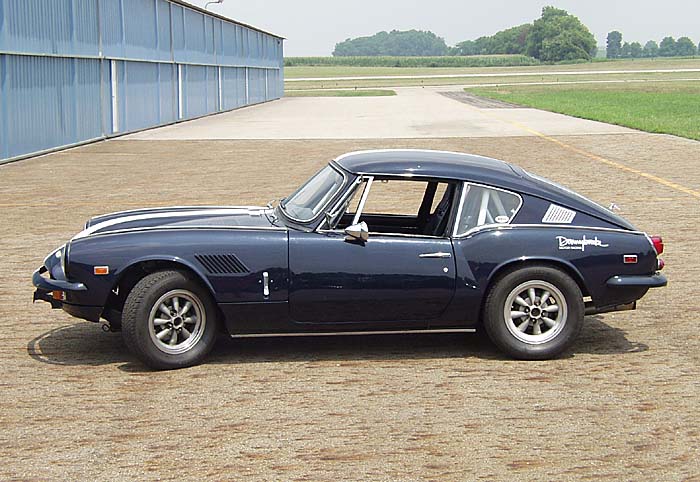
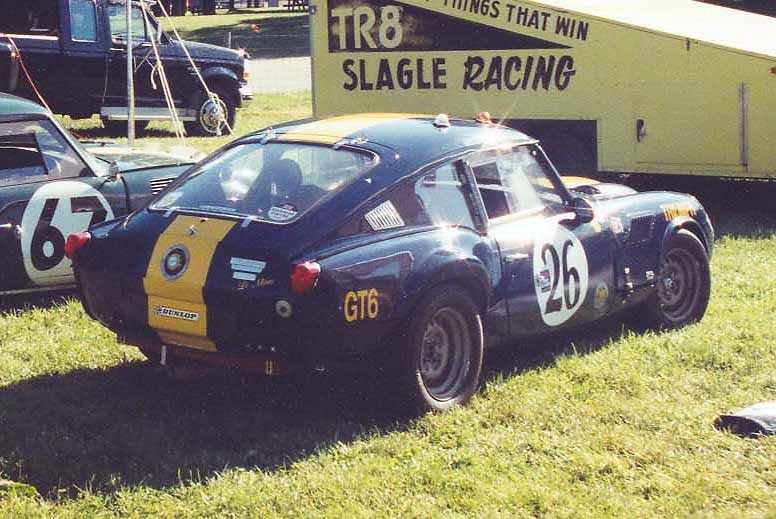
                    I bought the car a while back(Triumph GT6 sports car, the coupe version of a Triumph Spitfire) for $1200, as a gas car in need of restoration. Been working on it, repairing the body, electrical system, measuring it, building custom parts for it for when I turn it into an EV, rustproofed it(temporary paintjob on it at the moment), and even got it running as a gas car as of now. I don't have a working scanner or digital camera, otherwise pictures of my car would be floating around the internet, but here is what GT6s/Spitfires look like:


                    I'm not rich, or making a huge amount of money. I've been very slowly gathering parts as money slowly trickles in. In the event I get a job this summer(So far, there are no jobs around where I live, other than my one at my University I can only get a few hours a week at, if I'm lucky), I could have the car finished this year. Anything's a possibility.

                    And where do you get the parts and instructions to put this together?
                    Instructions?


                    Sorry, but there are no instructions. You have to figure this out yourself. Best way to learn is to talk to others who have built EVs. Ask them the process they went through, errors they made, parts they used, safety measurements taken, ect. The Electric Vehicle Discussion list, www.evdl.org, is the best place to start asking questions.

                    The instructions you have? Read your ass off.

                    Build Your Own Electric Vehicle by Bob Brandt and Convert It by Mike Brown are excellent books that cover most aspects of EV building and use, Brandt's book covering the physics and math of EVs and their parts, Brown's book covering the actual conversion process in detail. www.eaaev.org has a lot of material, being the electric auto association and all.

                    Parts?

                    All over the internet!

                    www.metricmind.com offers excellent AC drives, inverters, and lithium batteries. Top quality stuff, but pricey. None of my parts came from here.

                    www.evparts.com has everything you'd want for a DC conversion except for the propper batteries

                    http://www.cafeelectric.com/ sells Zilla controllers. They are great for electric musclecars and sportscars. I will most likely be using a Zila 1k, giving me 1,000 max motor amps, a 2k if I make a bunch of money this summer and decide mayber overhaulling my car's suspension, transmission and drive axel is within my cost range, bumping my conversion cost up a few grand but giving me 2,000 max motor amps and Dodge Viper/Corvette performance.

                    www.go-ev.com has some great motors. I'll be using the WarP 9'' myself. With 1,000 max amps and 216 max motor volts, I'm set for between 160 and 170 horsepower and 220-230 or so lb-ft of torque. 2,000 max motor amps? 275 horsepower and almost 400 lb-ft of torque. Better than the Advanced DC motors for high performance applications since they are built stronger, although essentially the same motors. Cheaper than ADC motors too. I hear efficiency is marginally less than their Advanced DC counterparts.

                    http://www.electroauto.com/ offers conversion kits and parts. Kits are generally expensive, but have everything ready to go for you to install with little hassle.

                    http://www.evsource.com offers a lot of EV components that you may find useful, such as Zilla controllers and stuff.

                    http://www.grassrootsev.com/catalog.htm offers a lot of stuff like evparts.com does, chargers, controllers, pot boxes, emeters, ect.

                    As for batteries, it depends on what you want to use.

                    AGM?

                    http://www.exideworld.com/products/a...bital_XCD.html offers Exide Orbitals

                    Lots of places all over the internet to buy Optima D750 Yellowtops from. Most places offer them at list price, $140+ per battery, but some offer them for $100 each.

                    Here's a breakdown of the parts cost for my car:

                    -WarP 9'' series DC motor x1 $1,395
                    -Optima D750 YT battery x25 $2,500
                    -Godzilla Controller(72-300V DC, 1,000 amp max) x1 $2,495
                    -PFC 20 Charger x1 $1,500
                    -Todd DC-DC converter x1 $400
                    -Steel for battery racks $50
                    -Battery Cable $50
                    -EV200AAANA contactors x2 $150
                    -Feraz Shawmut A50QS600-4 fuse x2 $220
                    -Curtis Potbox(To control acceleration) x1 $75
                    -E-Meter x1 $235
                    -Solid-State Ceramic Heater Core x1 $75
                    -Adaptor Plate x1 $1000(I will be machining myself, so don't count cost)
                    -Miscallaneous components(Heat shrink tubing, tools, ect.) $500
                    -Leaf springs from Renegade Hybrids $300 (increase GVWR)
                    -Rudman Powercheq Battery Regulators x25(Unassembled) $250
                    -x1 1969 Triumph GT6 Sports Car = $1,200

                    - restoration costs, including what I spent so far and what will be spent later: $1,000

                    Total = $12,395.

                    In the event I buy some parts used, price could drop drastically. When all is said and done, it is possible a car like this could be done for $7,000 total if used parts are gotten.

                    Quite a bargain, given that this will perform like $30,000-$40,000 sports cars, and get 80-100 miles range per charge, more than meets my needs. Long trips? I'll just charge at the homes of other EV owners I've talked to and continue on my way. A PFC 20 charger with buck enhancement would charge that battery pack in an hour from a 220V outlet.

                    As for hybrids, the Toyota Prius gets its most torque from the electric engine... 295ft lbs at 0-1200 rpms while the gas puts out a measly 82ft lbs (a fact i never knew till now) at 4200 rpms (most cars start running into the red at that rmp due to the fact the normal rpm average is 3000 for small and mid-size cars)!
                    I wasn't referring to the raw max torque, as that electric motor at 4,000 RPM isn't making much. If you find a torque vs RPM curve, look at the AREA under the curve. You will see my point. The electric motor isn't as used as much as it should be.

                    Besides, most cars go to 5,000-7,000 RPM to redline, not 3,000 RPM. My dad's Audi TT redlines at 6,500, my Spitfire at 6,000.

                    Most hybrids run off the electric motor if you are going under 35mph or until the electric power drops below a certain point in which the gas engine is turned on and is used to continue going and recharging the battery's.
                    But you can't run it in all EV mode by the push of a button like the ones in Europe, that let you use the entire battery pack for a few miles of full EV range. The all-electric limitation on the Prius motor is at 42 MPH.

                    Honda Insight doesn't have this all-EV feature, and it's very tiny in the hybrids that do have it. Almost unused.

                    Are quick charge stations a home charging station or a public recharging station? I live in Tucson, AZ and i've only seen one public charging station. In PHX however there more common. This is one reason why i think they didn't get popular is cause no one (ie. city, county, state, and federal governments)wanted to pay to install or operate charging stations.
                    These charging stations were problematic. They used the magnecharger system, instead of a standard 110V or 220V outlet, meaning all EVs equipped to plug into your standard wall socket couldn't use them, and any EV that could had to be carrying a $2,000 General motors magnecharge system.

                    The automakers should have just made EVs to plug into standard outlets, like Cocconi wanted for the EV1, which would use the inverter he designed, but since GM wanted to more money from consumer pockets, they'd rather force you to buy their expensive charger.

                    Now that most of the OEM EVs have been crushed, those chargers will go unused. There are hardly any vehicles equipped with magnecharge systems anymore!


                    Here in St. Louis, where I live, there's not a single electric car to be found. No charging stations, not that I'd need them. I'll be able to plug into a standard electrical outlet, like 99.9% of all other EV drivers.

                    Maybe NASCAR or someone should start an EV 100 or something of the sort and make it national, even worldwide. That would open peoples eyes super wide.
                    NASCAR is run and virtually owned by the auto and oil industries. Won't happen.

                    However, you may be pleased to hear of the National Electric Drag Racing Association.

                    www.nedra.com

                    About that AV Propulsion Civic you mentioned, it would cost $40,000 for a conversion kit and if the really massed produced it the cost would be $12,000 less which is still $28,000. So how is it a car like it would cost $20,000?
                    I think you misread the article. It stated:

                    With this high-performance EV comes a high price tag of $75,000, which includes the Honda Civic, battery pack, drivetrain and lower-output engine trailer. If you already have the car, a powertrain conversion package is available at $40,000, a price Cocconi says will drop to $12,000 if production reaches 1000 per year. With EVs from the major automakers being just promises at this stage, Alan Cocconi has leapt into the lead with a production-ready EV available to the consumer.

                    The drive system would drop to $12,000 in mass production, nott ake $12,000 off the price of the $40,000 kit.

                    The source I quoted which stated a $20,000 price tag for the car in units of 10,000 cars a year is as follows:

                    Sacramento News & Reviews, “Electric Smoke Screen”, by Nick Budnick, 7/6/1995, Page 19, –“ The rhetoric obscures the great strides electric vehicles have made in the last several years. A Southern California firm co-owned by Alan Cocconi, a former researcher with GM's electric vehicle program, has developed a 200-horsepower motor that propels a four-seater converted Honda Civic from zero to 60 mph in a mere 6.2 seconds, according to the July Road & Track magazine. The vehicle needs only two hours to recharge using a washer/dryer outlet. Of course, it costs $75,000; but Cocconi told the News & Review the high price is because it is a prototype, hand-built by the company's seven employees--not by an assembly line. "If you build 1,000 a year, it would be below $30,000; and if you build 10,000 a year, you get it down to around $20,000," he said.”

                    You read right.

                    And this was almost TEN years ago. EVs are cheaper to make than gas cars according to French automakers, even.

                    Dispelling another popular myth, Philippe Guédon - BlueCar designer and creator of the Renault Espace - told the Agence France-Presse that:
                    "Technically, electric cars are slightly less expensive to manufacture than petrol-powered cars. The problem of cost is primarily a result of low production volume."

                    (Translated from: Autoactu/AFP)
                    http://www.autoactu.com/data/0203200...05-164501.html

                    As for safety, you don't have to drop it on the battery terminals just to get shocked... look at the power cables that are carrying the juice? You have to bolt those to the controller unit or the motor right?
                    Yup. But only an idiot would work on the car with it turned on. Not turned on? Contactors not engarged?

                    No risk. Unless you're dumb enough to make yourself a bridge between the 'switch', which would be very hard to do.

                    The 10,000 volt warning i metioned came from a Toyota Newsletter warning mechanics of 10,000 volts capable from Hybrids.
                    That's misinfomation if I ever heard it. The hybrid battery packs don't even have 400 volts potential, let alone 10,000 volts. The Prius pack is only 274 Volts.

                    Besides, it's not volts that kill you, it's amps. Ever get shocked by static? Often in the tens of thousands of volts range.

                    However you do have to be aware of the fact that it only takes about 3 amps (the exact amount i noticed is not really known but im guessing there are many factors that determine how much actually stops a heart on an individual basis) and how many amps run an electric car?
                    More like .025 amps to kill you. 3 amps is no big deal though, factoring in the internal resistance of the human body. UNLESS that 3 amps is from a high voltage.

                    power = volts * amps

                    Remember this.

                    You said you could use an 1,000 amp controller? all i can say is be careful. No amount of knowledge or training can make accidents non-existent, and im assuming you know that already.
                    I'm being quite careful. But it's no more dangerous than simply leaving the car running on gasoline and working on it like that. The risks are different, but not more dangerous.

                    but all in all i do like EV's and i wish they mass produced em so us people who have little money, no time, or is just flat out lazy to build or get one built can get one by going to the local dealership. let me know how you EV comes out
                    I will let this entire site know when my EV is drivable. I've been working on it for so long. Many here are looking forward to it.

                    I'll even post videos of the races I participate in with this car, and even videos of me doing stupid things on the highway with it(Ever see an electric car go 140+ miles per hour on the highway? You will, one way or the other.).

                    maybe when i get older and amass more money i can build one, but by that time fuel cells or something better will exist...maybe.
                    Aside from the usual BS from the big three and big oil, the most optimistic projections of fuel cells have fuel cell cars being available by 2020 at five or six times more than the cost of a conventional auto. We don't even have enough platinum in the world for 1 million hydrogen fuel cell cars, let alone hundreds of millions of them. This little hurdle is a bit to be worked around.

                    It's stupid to ignore battery electrics at this point. The automakers are just biding their time, delaying the inevitable. If they don't do something, peak oil is going to bite us all in the ass. Starting to already. At this rate, 20 years from now, you'll be either driving an electric car, or riding a horse.
                    Last edited by The Toecutter; 04-07-2005, 03:49 AM.
                    The unnecessary felling of a tree, perhaps the growth of centuries, seems to me a crime little short of murder." ~ Thomas Jefferson

                    Comment


                      #40
                      Re: Why the electric car failed

                      I'm all for returning to horseback transportation. Automobiles are so cold and unloving. Plus, women will be "excited" all of the time with all that power between their legs. Yes, let us return to the ways of our forefathers! GET YOUR HORSE TODAY!
                      Lil' Bean is here!

                      Comment


                        #41
                        Re: Why the electric car failed

                        Booooooo...

                        Comment


                          #42
                          Re: Why the electric car failed

                          Excuse me, are you saying "Booooo" or "Buuuu-urns?"
                          Lil' Bean is here!

                          Comment


                            #43
                            Re: Why the electric car failed

                            Anyone ****ed off yet?
                            The unnecessary felling of a tree, perhaps the growth of centuries, seems to me a crime little short of murder." ~ Thomas Jefferson

                            Comment


                              #44
                              Re: Why the electric car failed

                              I sure as **** am.

                              I was watching "Love Boat" and the cable went out.
                              sig removed due to banned words being in playlist.

                              Comment


                                #45
                                Re: Why the electric car failed

                                And I was watching a young boy watching love boat when my binoculars went out!

                                Comment

                                Working...
                                X